


Bagheria
Bagheria is the nearest larger town to Porticello and lies halfway to Palermo. It's just under a ten-minute drive, and the same by train from Santa Flavia. Bagheria gained notoriety in the 1980s as a stronghold of the "Casa Nostra," Sicily's Mafia, and one of the three towns in the so-called "Triangle of Death." In recent years, Bagheria has worked hard to improve its image through small cultural projects and restorations.
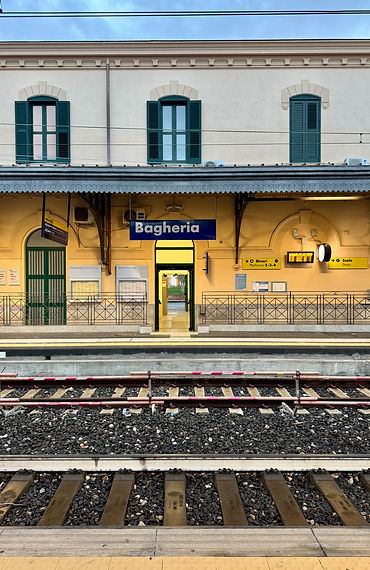

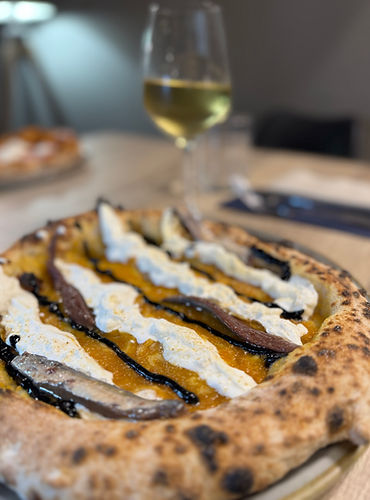

Just a short 10-minute drive from Porticello/S. Flavia: the town of Bagheria. Right by the train station you'll find: the graffiti mural created as part of a project to improve the townscape, unusual pizza creations at "Binario 450" and the Palazzo Cutò, which houses, among other things, the town library and whose grounds host open-air concerts and events in the summer.
Apart from the Villa Palagonia, Bagheria is not a city that ranks first in travel guides - but with its lively shopping street, nice bars, a number of grocery stores and restaurants with typical Sicilian products, it is a place where you can experience real authentic Sicilian life among locals!
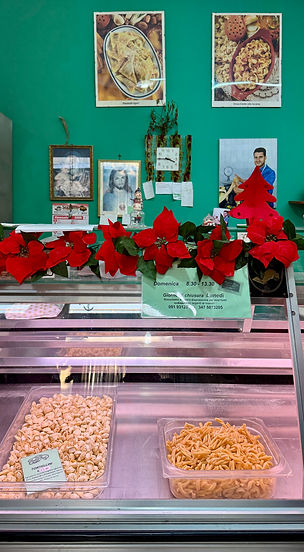


Frische handgemachte Pasta gibt es bei "Nonna Rosa", leckere Brot- und Backwaren in der Traditionsbäckerei "Ragusa". In der Carnezzeria "Tornatore" werden auch die Felle der geschlachteten Schafe verkauft.
Einst war Bagheria geprägt von prächtigen Villen, die reiche und adlige Palermitaner sich im 17. und 18. Jahrhundert außerhalb ihrer Stadt, entfernt von Lärm und mit Platz für Parks und Jagdgründe bauten. Mit dem Niedergang des sizilianischen Adels (Buchtipp: "Der Leopard" von Giuseppe Tomasi di Lampedusa) wurden die Villen verkauft oder vernachlässigt. In den 1950- und -60er Jahren wurde Bagheria Opfer von unkontrollierten Bauspekulationen durch die Mafia - mitten in Parkanlagen wurden teils ohne Vorschriften und Kontrollen minderwertige Gebäude hochgezogen, die auch heute noch das Stadtbild prägen. Der Kontext der Villen - Zufahrten, Alleen und Blickachsen - wurde zerstört. Große Tore oder Säulen, die ehemals Eingänge zu langen Parkzufahrten waren, sind heute Mahnmale eines verlorenen städtebaulichen Erbes. Das Buch "Bagheria" von Dacia Maraini beschreibt diesen Wandel der Stadt.


Large gates or columns that were once entrances to long park drives are now monuments to a lost urban heritage .
Of the original 44 villas, 33 still stand. Some of Bagheria's villas are privately owned, while others are open to the public. A must-see is Villa Palagonia, known as the "Villa of Monsters"! Adorned with grotesque sculptures, it is a symbol of eccentric aristocratic culture. Goethe visited the villa in 1787 during his "Italian Journey," but his opinion was not particularly positive: "Today we were preoccupied all day with the nonsense of Prince Palagonia," describing the villa and its figures as "Palagonian frenzy" and "rods of madness."
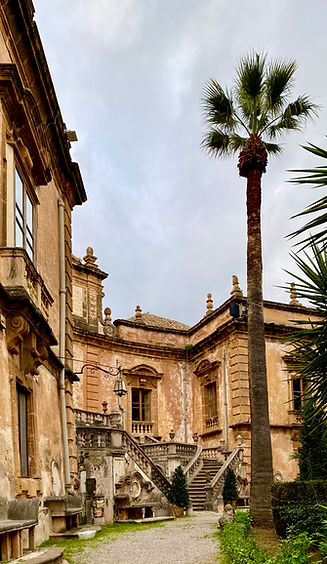

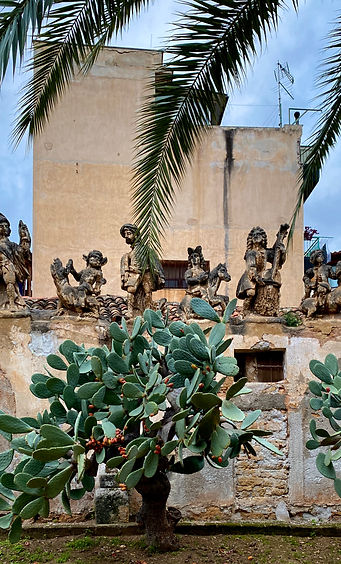
The Villa Palagonia, with its hall of mirrors and "monster figures," is definitely worth a visit!
Villa Cattolica is also open to the public and houses a museum of modern and ethnological art. Unfortunately, little of the original interior furnishings remains.


Villa Cattolica borders a former cement factory - a clash so typical for Bagheria between former splendor and urban planning sin, which here almost has a special charm.
Bagheria offers a good selection of restaurants serving authentic regional cuisine. We particularly enjoy "Da Dario," which offers delicious, typical Sicilian dishes. A unique dining experience awaits at the Trattoria "Don Ciccio": each guest receives a paper napkin from the waiter himself, and the appetizer is a sweet Zibibbo liqueur and a boiled egg. "Binario 450" serves modern interpretations of pizza, and in the charming seaside suburb of Aspra, the Restaurant Rino, which is barely noticeable from the outside, offers upscale dining with fresh fish.


The rustic ambience of the Trattoria "Don Ciccio" and typical Sicilian appetizers at "Da Dario" - Bagheria offers many opportunities to get to know the regional cuisine!
The seaside district of Aspra is particularly charming: here, children swim on the sandy beach amidst brightly painted fishing boats and fishermen mending their nets. When the sun sets behind Monte Pellegrino near Palermo, the sea is often bathed in spectacular colors. That's why Aspra is our favorite spot for a sundowner, perhaps a Bellini or an Aperol Spritz. The best order of operations is: first an aperitif with sunset in Aspra, then dinner in Bagheria! To reach Aspra, however, you'll need a scooter or car – while you can easily get to Bagheria from Porticello by train in just a few minutes, Aspra unfortunately isn't connected to public transportation.
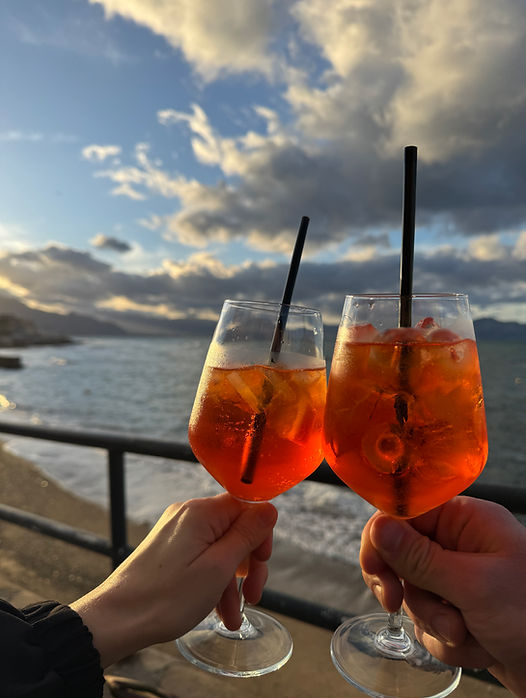

Perfect for an aperitif: In Aspra, there is always a spectacular evening sky when the sun sinks into the sea behind Monte Pellegrino!